By WorldwideScope World Desk
September 15, 2026
The U.S. military’s war with Iran has exposed a problem that could extend well beyond the battlefield: America’s ability to replenish some of the advanced weapons it uses in a major conflict.
A new assessment from the Pentagon’s watchdog has found that the U.S. campaign against Iran created strategic shortfalls in some munitions and revealed bottlenecks in the American defense-industrial base. The findings come as the cost of Operation Epic Fury has climbed to approximately $33.4 billion through June 30, according to reporting on the Pentagon assessment. About $22.3 billion of that total was attributed to munitions, while equipment losses accounted for another $3.7 billion.
The report offers a rare look at the strain that a high-intensity conflict can place on even the world’s largest military.
It also raises a broader question for Washington: Can the United States replace sophisticated weapons quickly enough if another large-scale conflict requires sustained combat operations?
A $33.4 Billion War Bill
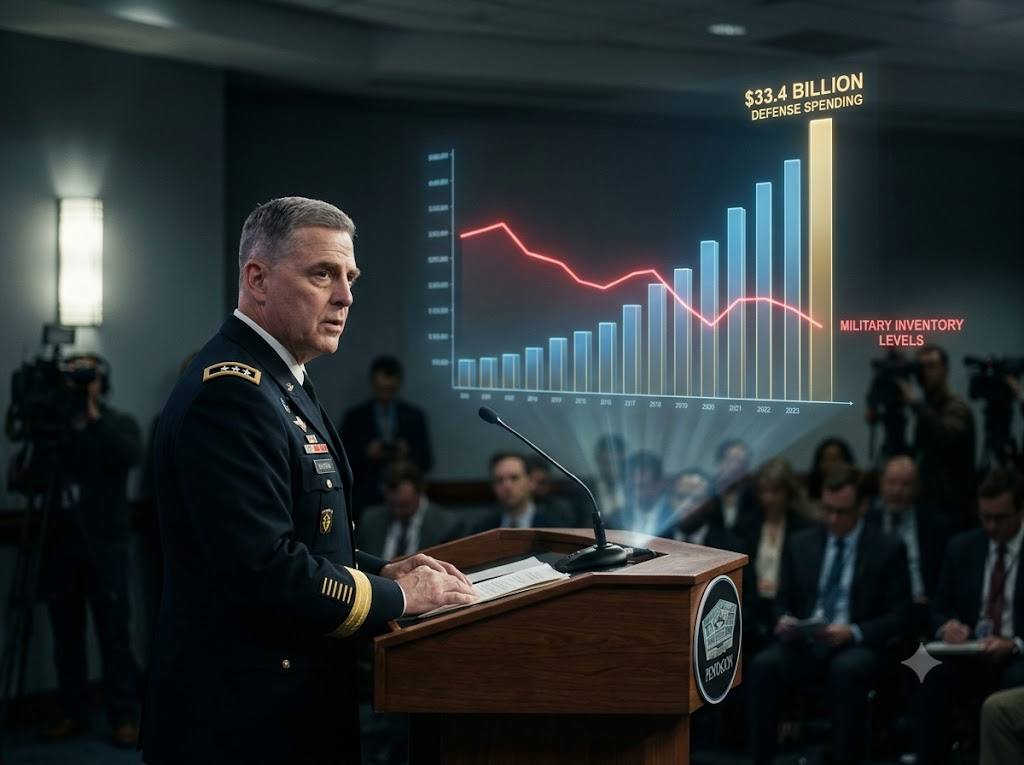
Operation Epic Fury began on February 28 and continued through June 30, according to the reporting surrounding the Pentagon watchdog’s assessment.
The estimated $33.4 billion cost covers the U.S. military’s operations during that period. The largest component was the use of munitions, with approximately $22.3 billion worth of weapons expended. Equipment losses added billions more to the bill.
The numbers are significant not simply because of the financial cost.
Modern warfare increasingly depends on weapons that can be extremely expensive and difficult to manufacture. Precision-guided missiles, sophisticated interceptors, advanced bombs and other systems require specialized components, explosives, electronics and highly trained workers.
Replacing those weapons is therefore not comparable to simply increasing production of conventional ammunition.
The Munitions Problem
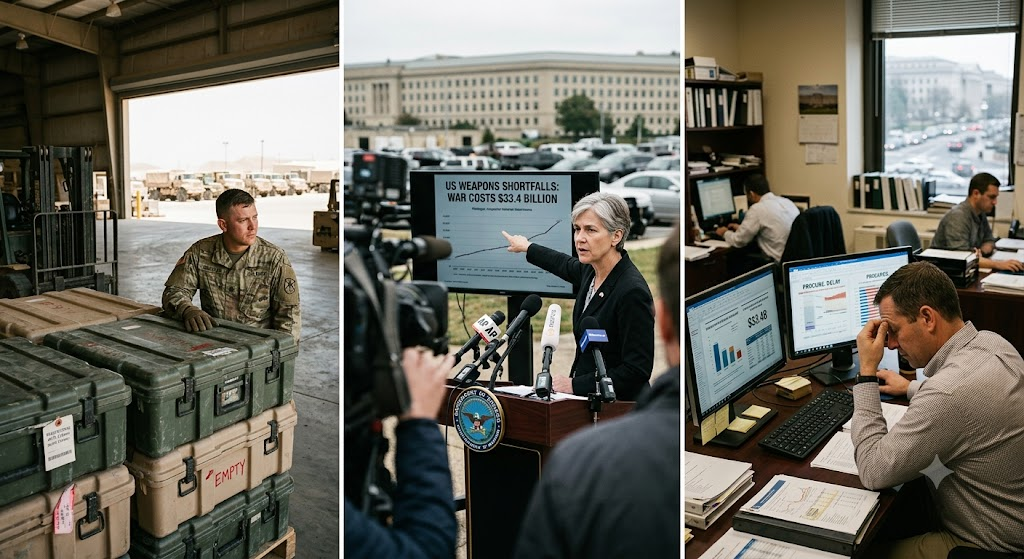
The Pentagon watchdog’s findings point to what it described as strategic inventory shortfalls.
The assessment also identified bottlenecks in the industrial base responsible for producing weapons and ammunition. Reporting on the findings has highlighted constraints involving solid rocket motors, high-grade explosives and propellants, as well as shortages of skilled workers.
That matters because the United States has spent years maintaining a military designed around technological superiority and precision.
The strategy works particularly well when advanced weapons are available in sufficient quantities.
But a prolonged conflict can change the equation.
If weapons are being used faster than factories can replace them, the issue becomes one of industrial capacity rather than simply military spending.
In other words, having the world’s largest defense budget does not automatically mean having an unlimited supply of every weapon system.
Aircraft and Drone Losses Add to the Pressure
The conflict also imposed a substantial toll on U.S. military equipment.
The Pentagon watchdog’s assessment found that up to 30 MQ-9 Reaper drones were lost or damaged. The report also identified damage or losses involving aircraft, including seven KC-135 aerial refueling tankers.
The Reaper is an important U.S. surveillance and strike platform, while tanker aircraft are critical to sustaining long-distance air operations.
The significance of tanker losses is particularly important in a geographically large conflict.
Fighter aircraft and other combat platforms depend on aerial refueling to remain airborne for extended periods and operate far from their home bases.
Damage to logistical infrastructure can make that challenge even harder.
Iran’s Attacks Reached U.S. Bases Across the Region
The watchdog’s assessment also describes significant damage to American military infrastructure.
Iranian strikes damaged or destroyed hundreds of buildings at U.S. bases across several countries in the Middle East, according to the assessment reported by AP. American facilities in places including Bahrain, Kuwait and Saudi Arabia were affected.
One particularly important target was the U.S. naval facility in Bahrain.
Damage to logistics infrastructure forced the U.S. military to adjust supply routes and shift some operations toward more distant locations, including Diego Garcia.
That created additional logistical pressure.
Military power is not just about aircraft, ships and missiles. It also depends on fuel, spare parts, maintenance facilities, runways, warehouses, communications systems and supply networks.
When those systems are damaged, the cost of maintaining combat operations can rise rapidly.
The Hidden Cost of Modern Warfare

The $33.4 billion headline figure does not necessarily represent the full long-term economic burden of the conflict.
Weapons that have already been fired must be replaced.
Aircraft that were destroyed or damaged require repair or replacement.
Military bases need reconstruction.
Supply chains have to be restored.
And workers and factories must increase production to rebuild inventories.
The Pentagon watchdog’s findings therefore highlight a distinction between the cost of fighting a war today and the cost of preparing to fight the next one.
Those costs can continue long after combat operations have ended.
Why America’s Defense Industry Matters
The United States remains one of the world’s most powerful military and industrial nations.
But modern weapons depend on complicated supply chains.
A missile may require a rocket motor, guidance electronics, specialized explosives, sensors, software and numerous components manufactured by different suppliers.
If even one critical part has limited production capacity, increasing output of the final weapon can become difficult.
This is why the Pentagon’s concerns about industrial bottlenecks are strategically important.
The problem isn’t necessarily a lack of money.
It can be a lack of production capacity.
The Pentagon has already been pushing defense companies to accelerate weapons production and replenish diminished stockpiles.
But expanding a specialized defense-production line can take years.
Factories need equipment, contracts, raw materials and skilled workers. Some components also require highly specialized manufacturing processes.
That makes the defense industrial base a strategic asset in its own right.
A Warning for Future Conflicts
The Iran war could become a case study for U.S. military planners.
For decades, American forces have enjoyed enormous technological advantages and access to precision weapons.
But future wars may be larger, longer and more demanding.
A conflict involving a major military power could require the United States to maintain operations across multiple theaters while simultaneously supporting allies.
That creates a difficult strategic calculation.
How many advanced weapons can the U.S. produce every month?
How quickly can critical inventories be rebuilt?
Which weapons are most vulnerable to shortages?
And how much industrial capacity would be needed if another major conflict began before existing stockpiles were fully restored?
These questions are becoming increasingly important as Washington focuses on both current threats and long-term military competition.
The Bigger Geopolitical Picture
The report also arrives at a time when the United States is facing growing military challenges from multiple directions.
China’s military modernization, Russia’s large-scale weapons production and the continuing instability across the Middle East are forcing American planners to think beyond a single conflict.
A military can be technologically superior and still face difficult choices if its most advanced weapons are consumed faster than they can be replaced.
That is particularly relevant for expensive precision systems.
The Iran conflict therefore provides a real-world test of America’s ability to combine technological superiority with sustained industrial production.
What the Report Really Reveals
The most important message from the Pentagon watchdog assessment may not be the $33.4 billion price tag.
It may be the warning about capacity.
America possesses enormous military resources, but modern warfare can consume those resources at extraordinary speed.
The United States can spend billions rebuilding its stockpiles, but money alone cannot instantly create factories, skilled workers or specialized supply chains.
The conflict has demonstrated the importance of maintaining not only a powerful military but also a defense-industrial system capable of replacing what that military consumes.
For Washington, the challenge now moves beyond the battlefield.
It is about rebuilding inventories, expanding production and ensuring that the United States is not caught unprepared if another major conflict demands sustained use of advanced weapons.
WorldwideScope Takeaway
The Iran war has delivered a costly lesson for the United States: military dominance depends not only on having the world’s most advanced weapons, but also on being able to replace them fast enough.
The Pentagon watchdog’s warning about munitions shortages and industrial bottlenecks could therefore become one of the most consequential lessons of the conflict.
For America’s military planners, the next battle may begin long before the first missile is launched — inside factories, supply chains and weapons-production facilities across the country.
1 thought on “Pentagon Watchdog Warns of U.S. Weapons Shortfalls After Iran War as Costs Reach $33.4 Billion”